Texas has one of the most interesting presidential stories in American history. From leading its own country to being home to influential U.S. presidents, the adventure brings together big personalities, bold decisions, and a strong sense of state pride.
Here, I’m breaking down the leaders who shaped Texas as a nation and the Texans who went on to leave a mark on the White House. This covers the Republic era, statehood, and famous leaders you’ve probably heard about, whether you’re a history buff or just curious about how Texas fits into the presidential lineup.
Republic of Texas Presidents the Leaders Before Statehood
When Texas declared its independence from Mexico in 1836, it set up its own government, complete with its own president. Running an independent republic only lasted about a decade, but these leaders each played big roles in setting up the state’s future.
Here’s a look at the main presidents from the Republic period and a quick rundown of what they did during their terms:
- David G. Burnet (March – October 1836): Appointed as interim president during the chaotic months of the Texas Revolution. He’s probably best remembered for handling government business as Houston led military forces. His short tenure was packed with urgent decisions; his leadership kept Texas on track during its first steps as a new country.
- Sam Houston (1836–1838; 1841–1844): Elected as the first president of Texas, Houston had already become a hero after the Battle of San Jacinto. He pushed for annexation to the U.S. and was known for being practical, even when politics got messy. He served two nonconsecutive terms, staying popular for his knack at managing conflicts and debts.
- Mirabeau B. Lamar (1838–1841): Lamar, the republic’s second president, brought a totally different vibe. He strongly opposed annexation and wanted to expand Texas’s borders toward the west. Sometimes his actions led to conflict, especially with Native American tribes, and he focused a lot on promoting public education. That’s why he’s still called the “Father of Texas Education.”
- Anson Jones (1844–1846): The last president of the republic, Jones finished what Houston had started. He oversaw the transfer of Texas from an independent nation to becoming America’s 28th state. His work, while quiet, was absolutely central to wrapping up nearly a decade of Texas independence. People sometimes call him the “architect of annexation.”
During the Republic years, Texas wrestled with everything from managing debts to signing treaties, fighting off raids, and figuring out the best way to join the U.S. These early leaders weren’t just politicians; they were pioneers in every sense of the word, laying the groundwork for Texas’s spirit and future.
Texas and the U.S. Presidency: Lone Star Influences in D.C.
After annexation, Texas slowly built a reputation for producing national political figures. While presidents from all over the country have shaped the Oval Office, not too many can say they were truly Texans. The ones that do pop up on the list highlight how Texas-style leadership remains a real force in American government.
Texas-Born Presidents
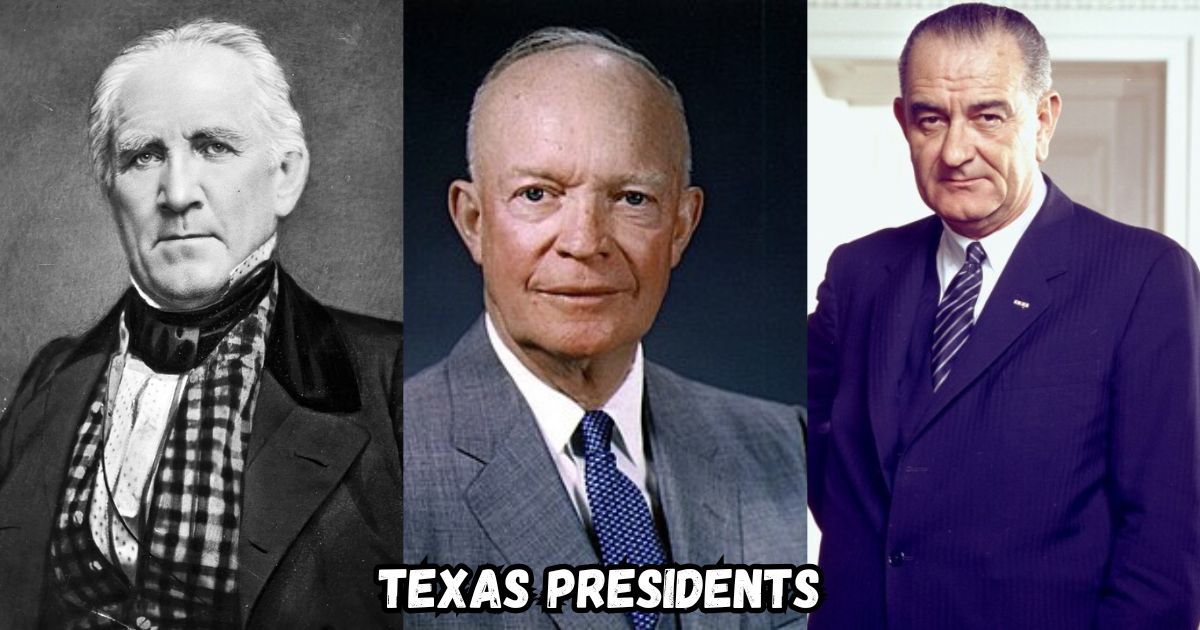
- Dwight D. Eisenhower (34th President, 1953–1961): Born in Denison, Texas, in 1890, Eisenhower famously went on to become a five-star general and led Allied forces in Europe during World War II. While most of his childhood and schooling happened in Kansas, his Texas roots are still mentioned today, especially by local historians. Eisenhower brought calm, practical leadership and steered the country through some tense Cold War years, earning a reputation for being steady under pressure.
- Lyndon B. Johnson (36th President, 1963–1969): Born in the Hill Country near Stonewall, Texas, Johnson’s upbringing shaped his policies as a senator, vice president, and eventually president after John F. Kennedy’s assassination. LBJ’s Texas ties showed in his down-to-earth style and focus on big projects like civil rights, education, and healthcare. The Johnson Ranch and the LBJ Presidential Library in Austin both keep his legacy front and center in Texas history. Johnson’s push for the “Great Society” programs came right out of his Texas background.
Presidents Deeply Linked to Texas
- George H.W. Bush (41st President, 1989–1993): Born in Massachusetts, Bush built his oil business and political career in Texas after serving as a Navy pilot in World War II. He started in Midland and Houston, then won a seat in Congress representing Texas before taking on national roles like CIA Director and Vice President. His time as president focused on foreign policy and guiding the U.S. through the end of the Cold War, all while maintaining close connections to Texas events and communities.
- George W. Bush (43rd President, 2001–2009): Although born in Connecticut, he was raised in Midland and Houston. George W. Bush’s Texas identity grew even stronger after he served as Governor for two terms before getting elected to the White House. His style combined Texas confidence with folksy directness, and he made attention to education, national security, and the aftermath of 9/11 main features of his presidency. His Crawford ranch solidified his image as a hands-on Texan leader.
While Eisenhower and Johnson were actually born in Texas, the Bush family’s legacy in Texas is hard to miss in American politics. Their homes, businesses, and post-office activities all keep them firmly entrenched in Texas culture; countless speeches and public projects remain rooted in the Lone Star State.
Key Events in Texas Presidential History
Certain events stand out in the story of Texas and the presidency. Here are some memorable moments and interesting trivia that help explain why Texas holds such a unique place in the American imagination:
- 1836: Texans cast one of their first national votes by supporting annexation (3,277 votes in favor, only 91 against). This early vote set the stage for statehood conversations and shapes state pride to this day.
- 1845: Texas officially joins the U.S. after negotiating for the right to break into five states if it wants—a quirky detail that comes up in Texas trivia nights and history books. This right, unique to Texas, is still sometimes referenced in debates about Texas’s distinctive place in America.
- 1963: Vice President Lyndon B. Johnson is sworn in as president aboard Air Force One in Dallas after JFK is assassinated. This somber moment put Texas at the center of U.S. history during one of its darkest hours.
- 1997: George W. Bush begins his second term as Texas governor, launching his path to the White House with new initiatives on education and business.
- Presidential Library Hub: Texas is home to three official presidential libraries: LBJ in Austin, George H.W. Bush in College Station, and George W. Bush in Dallas. No state has more, making Texas a center for presidential research, learning, and commemoration.
This mix of early independence and sustained national influence means Texas keeps turning up in conversations about American leadership. Even today, politicians often campaign on the idea of “Texas values”, wrapping up loyalty, grit, and a sense of possibility.
Early Presidential Elections in Texas
The Republic of Texas didn’t waste any time in setting up a democratic system. From the start, elections brought together residents from all over to vote for their own head of state. Here’s how voting looked in the Republic years:
- Public Voting: Elections were held for president, vice president, and Congress. Turnout was small compared to today, sometimes only a few thousand voters, but it set the stage for future engagement.
- Two-Term Max: Only Sam Houston served two nonconsecutive terms, setting a precedent for how Texans might value both experience and new ideas. Other presidents served one term, as fresh voices and options were always in demand.
- Big Issues: Each election focused on land policy, debts from the revolution, Native American relations, and whether Texas should join the U.S. or stay independent. These debates brought serious passion to the polls each time citizens voted.
This period didn’t just shape Texas politics; it helped set a tradition of high public involvement whenever the question of leadership came up. It’s easy to spot echoes of that dedication in state and national elections even now.
Common Questions About Texas Presidents
People often have a lot of questions about Texas and the presidency. Here are some I hear pretty often, along with my best answers:
How many presidents has Texas had?
Four presidents during its time as a republic – Burnet, Houston, Lamar, and Jones. As for the U.S. presidency, two were born in Texas (Eisenhower, Johnson), and two others (George H.W. Bush, George W. Bush) are closely identified with the state. That mix of homegrown and adopted leaders adds depth to Texas’s history.
Does Texas have any unique powers because of how it joined the U.S.?
Texas has a few quirky legal facts tied to its annexation. For example, it holds the historic right to split into multiple states, but these details don’t give Texas any different powers today compared to other states. The Lone Star State can’t just leave the union or override federal law, but it loves its unique backstory.
Why is Texas important in modern presidential politics?
With its booming population and political clout, Texas sends a large number of electoral votes in national elections. The “Texas way” is also an ongoing theme for politicians who want to emphasize independence, toughness, or frontier spirit, adding a layer of drama to presidential campaigns.
Interesting Facts and Places to Visit
Texas’s presidential story is full of unique landmarks and bits of trivia worth checking out:
- LBJ Ranch and Library: Located in Stonewall and Austin, these spots offer a real look into the life and work of Lyndon B. Johnson. The riverside ranch, especially, is where he would unwind and host national leaders, turning Texas into a backdrop for political history.
- Eisenhower Birthplace State Historic Site: In Denison, you can see the childhood home of America’s 34th president, filled with artifacts and family stories. The small-town charm adds a personal touch to presidential history.
- George Bush Presidential Library and Museum: Both H.W. Bush (College Station) and W. Bush (Dallas) have massive collections. These museums are great for history fans and show off everything from campaign materials to personal mementos.
- Texas White House: Johnson’s ranch served as a “second White House,” hosting guests and running affairs of state. You’ll get an up-close look at mid-century politics and life in the Hill Country, all while standing on the grounds where major policies took shape.
You’ll find reminders of Texas presidential history all over the state, from college campuses to small-town museums and roadside historical markers. If you’re planning a Texas trip, these are worth adding to your list, as each stop brings presidential stories to life and helps you get a feel for Texas’s political legacy.
Modern Texas and Presidential Legacies
Even after the days of the republic, Texas hasn’t stopped producing influential leaders. From Sam Rayburn in Congress to Ann Richards and Rick Perry as governors, running for president often means looking to Texas for ideas or support. Modern campaigns are always trying to tap into that Lone Star style, making Texas a go-to stop on the road to the White House.
What stays with me is how the spirit of those early days—risk-taking, independence, and vision—continues through every Texan who steps onto the national stage. Whether you’re fascinated by history or just want to know why Texas politics keeps grabbing headlines, the legacy of its presidents is a story worth checking out and thinking about next time you see Texas on the news.
Most Recent Articles:
- Texas Folklife Festival: Preserving Traditions
- Rodeo Events That Celebrate Texas Culture

- Texas Historic Cattle Drives And Cowboy Festivals
- Fiesta De La Flor: Honoring Selena And Tejano Heritage

- Battle Of Gonzales Reenactment: Preserving History

- Texas Renaissance Festival: A Historical Experience

As always, stay safe, enjoy the journey, and please try to leave Texas cleaner than you found it. If you have any comments, questions, ideas, or suggestions, please leave them in the comment section below, and I’ll get back to you ASAP. You can follow us on TikTok @texasthenandnow or YouTube @TexasThenandNow for videos of all things Texas.
P.S. Thanks so much for checking out our blog; we really appreciate it. Just so you know, we may receive a commission if you click on some of the links that appear on our site. This helps us keep our content free and up-to-date for everyone. We appreciate your support!
